
What Do Eighth Graders Learn in Math? A Homeschool Guide
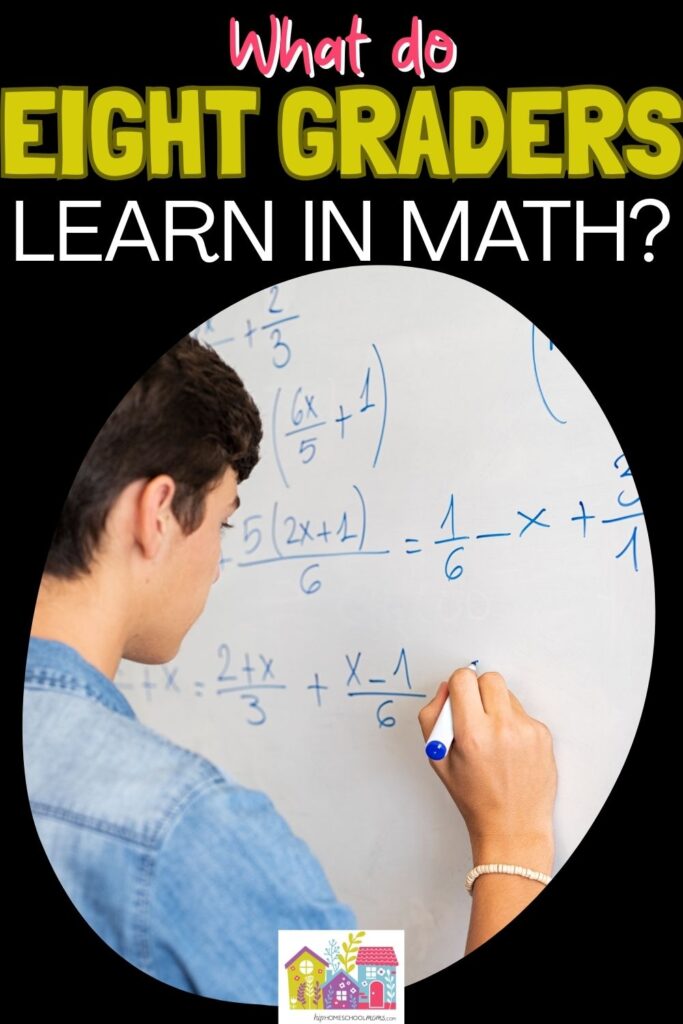
Math hasn’t always been my favorite subject. (I’d rather curl up with Jane Austen than quadratic equations, thank you very much.) Growing up, I never had a good math teacher, so numbers always felt intimidating. Forget what the average eighth graders learn in math: I was probably barely at a fifth-grade level in math throughout middle school!
But then in college, I landed in an algebra course with a professor who explained things clearly—and it changed everything. Suddenly, I got it. I went on to earn straight A’s in every math class I took after that.
Even so, when it came time to homeschool my own kids, teaching math was still a challenge. At some point, I found myself Googling, “What do eighth graders learn in math?” because knowing how to do math isn’t the same thing as knowing how to teach it. If you’ve ever felt the same way, you’re in good company.

The good news? You don’t have to be a math whiz to guide your eighth grader through this year. Here’s a look at what eighth grade math covers, plus some tips for making it less overwhelming at home.
Key Concepts Eighth Graders Learn in Math
Eighth grade is often considered a “bridge year” between middle school math and high school-level algebra. Students move beyond basic computation and really start flexing those abstract thinking skills. Topics typically include:
Linear equations and functions – understanding variables, graphing, and analyzing patterns.
Exponents and roots – including squares, cubes, and their inverses.
The Pythagorean Theorem – working with right triangles and applying a² + b² = c².
Geometry concepts – transformations, angles, similarity, and congruence.
Inequalities – solving and graphing them on a number line.
Statistics and probability – interpreting data, calculating averages, and making predictions.
Ratios and proportional relationships – applying math to real-life word problems.
By the end of eighth grade, students should be ready to step confidently into Algebra I.
The Things Eighth Graders Learn in Math Matters
This year lays the groundwork for high school math. Without a solid foundation in algebraic thinking and problem solving, the transition to Algebra I (and beyond) can feel like jumping into the deep end without knowing how to swim.
That’s why steady, consistent practice is so important—not just to “get through” the material, but to build real understanding.

Tips for Teaching Eighth Grade Math at Home
Choose a strong curriculum.
A program that explains concepts clearly can make a world of difference. We’ve found that CTCMath does this beautifully—it teaches step by step, offers practice questions, and gives immediate feedback.Aim for understanding, not just right answers.
Encourage your child to explain how they solved a problem. This helps catch misconceptions early and strengthens their reasoning skills.Keep lessons consistent.
Short, daily practice beats occasional marathon sessions every time. Math builds on itself, so steady exposure is key.Use visuals and examples.
Graphs, number lines, and even quick doodles can help students “see” the math, making abstract concepts more concrete.Normalize struggle.
Remind your child (and yourself!) that math isn’t always easy—and that’s okay. Mistakes are part of the learning process.
Why We Like CTCMath
CTCMath has been our go-to for middle school math. The lessons are short, easy to follow, and online—so my kids can work independently while I sip my tea (or catch up on laundry).
It also has diagnostic tools to identify gaps, so you’ll know exactly what your student needs to work on before moving into high school math. And best of all? The grading is automatic. Enough said.

Final Thoughts
All that stuff eighth graders learn in math can look intimidating, but it doesn’t have to be overwhelming. With the right tools and a little consistency, your student can build confidence and be well-prepared for the challenges of high school math.
And who knows—you might even find yourself enjoying the journey along the way.
Free Trial
I highly recommend you give it a try! You will find a link to it below.
Try CTCMath!
Check out our other posts in this math series:
- What Do Seventh Graders Learn in Math? A Homeschool Guide
- Six Ways to Convince your Sixth Grader Math Is Cool
- Homeschool Math for a Fifth Grader (What I Wish I Knew Earlier)
- 4th Grade Math through the Seasons
- Top Tips for Teaching 3rd Grade Math in Your Homeschool
- 10 Tips for Teaching Math to Second Graders
- Fun Ways to Teach Math First Graders Will Love
- Build a Strong Foundation in Kindergarten Math