
What Do Seventh Graders Learn in Math? (A Quick Guide)


What Do Seventh Graders Learn In Math?
Some people can rattle off equations and formulas as easily as I can rattle off lines from Pride and Prejudice (or, more recently, binge my way through eight Emma M. Lion books in a single week). Alas, math and I have never had that sort of cozy companionship. Numbers don’t curl up beside you on the couch with a cup of tea. They glare at you from the page, demanding to be solved.

And then, somehow, we find ourselves here: seventh grade. Middle school math. The point in the homeschooling journey where moms everywhere suddenly say, “Wait … what exactly is an integer again?”
If you’re like me, you might need a quick refresher on what’s coming this year. So let’s take a look at what seventh graders actually learn in math. Spoiler: it’s not just long division anymore. (Although some of us are breathing a sigh of relief about that: raise your hand if you didn’t love the tedium of long division, for yourself or your kids.)
The Big Topics in 7th Grade Math
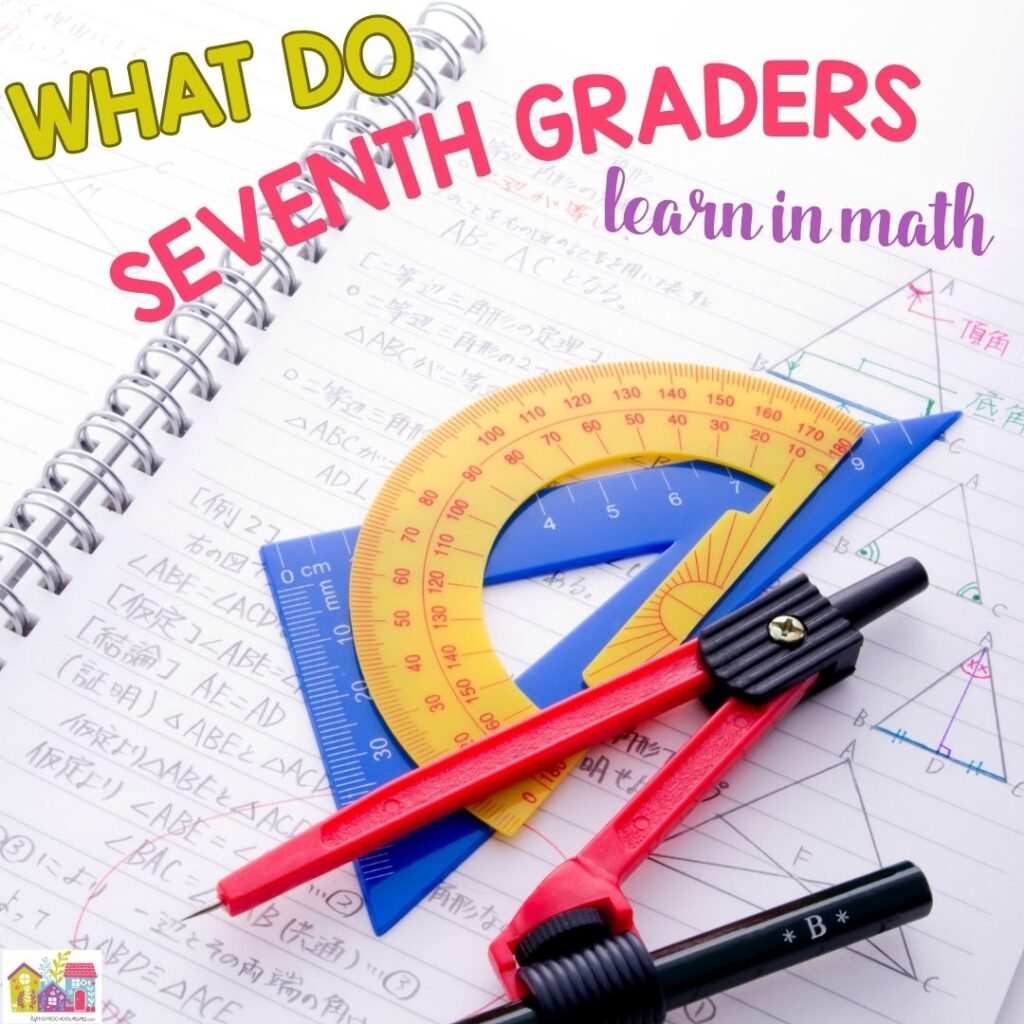
So, in answer to the question I know you’re asking in hopes of getting a bit ahead of the game (and thereby hopefully get in a bit more reading time): What do seventh graders learn in math … here’s a quick list of what’s typically covered in the first year of middle grade math.
Think of this overview as the syllabus for the year—minus the coffee stains and panic.
- Integers and Rational Numbers – Positive numbers, negative numbers, fractions, and decimals all in the same playground.
- Ratios and Proportions – Figuring out things like “If three books cost $12, how much for seventeen books?” (Answer: probably more than your monthly coffee budget.)
- Percents – Discounts, interest rates, tax… all those things your seventh grader will learn just in time to side-eye you about overspending at Barnes and Noble.
- Expressions and Equations – Writing and solving equations with variables (a.k.a. the magical place where letters start crashing the number party).
- Inequalities – Figuring out what’s greater, what’s less, and how to put it in mathematical shorthand.
- Geometry – Area, perimeter, volume, angles, circles—basically, math with shapes.
- Probability and Statistics – A little intro to how likely things are (like the probability of you remembering how to graph data from 25 years ago).
- Problem-Solving and Word Problems – Where everything above is mashed together in a question involving trains, apples, or mysteriously leaking bathtubs.
So, pop quiz: What do seventh graders learn in math? In short, it’s a year of transitioning from “arithmetic” to “real pre-algebra.” This is where the foundation for higher math is being set, and—deep breath—it’s okay if that feels intimidating.
But What If Math Isn’t Your Thing?
If you’d rather spend an afternoon rereading Doyle or tackling your latest historical-fiction find, I completely understand. Once you have the answer to that question: What do seventh graders learn in math? … it’s time to take the list of things they learn, and actually start teaching those things to your kids!
And teaching math at that level can feel a bit like slogging through a swamp without a map—especially if it’s been a couple of decades since you last dealt with variables.
That’s exactly why I love CTCMath. It’s an online math curriculum that covers every grade level, from kindergarten through high school, but it’s especially wonderful in middle school when moms tend to start losing confidence. The lessons are short and clear (no long-winded lectures), and the practice problems actually reinforce what’s taught instead of leaving kids—and moms—feeling lost.
I like that I can let my child work independently, but I still have the option to track their progress. Honestly, it takes so much pressure off me. No more late-night Googling “how to solve two-step equations” or feeling guilty that I can’t explain percentages without resorting to the grocery store clearance rack.
The Bottom Line
Seventh grade math is where things start to feel “big kid.” It’s no longer just adding and subtracting; it’s the launchpad into algebra, geometry, and beyond. Whether your student soars through numbers or drags their heels like they’re being asked to recite Latin declensions, the important thing is having tools and resources that make the journey smoother—for both of you.
And if you, like me, sometimes feel more at home in a library than at a chalkboard full of equations, then take heart: you don’t have to do this alone. CTCMath can bridge the gap, giving your child a solid foundation while letting you enjoy at least one more character arc in your favorite series this week without guilt.

A Little More about CTCMath
CTCMath isn’t just another math curriculum. It feels like it was created with you in mind—the mom who loves teaching creatively but also needs structure, clarity, and support when the concepts get tough… and maybe isn’t exactly a math whiz 🙂
Here’s what wins you over:
- Short, clear video lessons taught by someone who makes math sound surprisingly reasonable and less intimidating.
- A self-paced format, so your kids can work ahead when they’re flying—or rewatch when something doesn’t quite stick.
- Automatic grading, so you’re not stuck checking worksheets while second-guessing yourself or Googling, “how to subtract mixed numbers.”
- One subscription for the whole family, so you don’t have to choose which child gets a solid math education and which one learns by osmosis.
You try the free trial. Your kids don’t complain. You don’t hyperventilate. That alone feels like a miracle. And you don’t need to know every part of the answer to “What do seventh graders learn in math?” You get some help there!
But you know what’s even better? Their 365-day money-back guarantee. No questions asked. No fine print. No stress. You can try it—really try it—with zero risk. If it’s not the right fit, you get your money back. Period.
Looking for tips on teaching math to other grades? Maybe instead of wondering, What do seventh graders learn in math, you’re asking that for sixth grade or fifth. If so, check out the other posts in our math series:
- Six Ways to Convince your Sixth Grader Math Is Cool
- Homeschool Math for a Fifth Grader (What I Wish I Knew Earlier)
- 4th Grade Math through the Seasons
- Top Tips for Teaching 3rd Grade Math in Your Homeschool
- 10 Tips for Teaching Math to Second Graders
- Fun Ways to Teach Math First Graders Will Love
- Build a Strong Foundation in Kindergarten Math