
Ninth Grade Math for Homeschoolers (What to Teach And How to Survive)
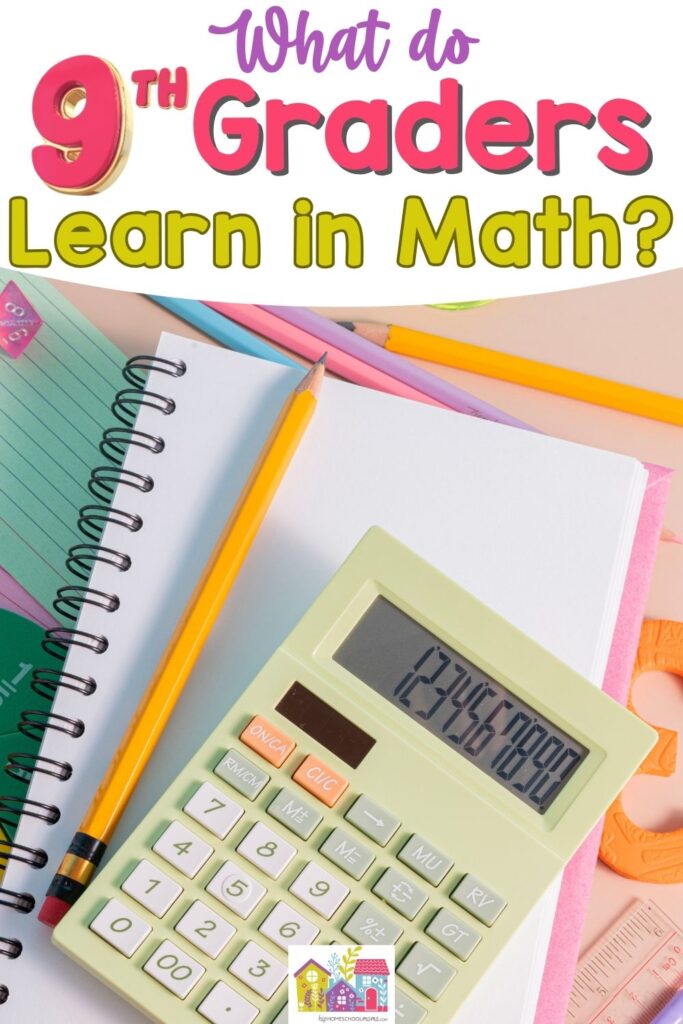
So, it’s your kid’s first official year of high school. Somehow, it feels like the training wheels just came off, doesn’t it? The stakes feel higher now—grades start to “count,” transcripts become a thing, and suddenly there’s talk of graduation requirements and college credits. And then there’s ninth grade math.
The first year of high school is a big milestone if you’re a homeschool mama who’s made it this far in the homeschool game. And even if it’s not your first rodeo–as in, you have older teens who’ve already passed through ninth grade math and beyond–each child is so different and it can feel like you’re starting over again each time.
Whether your teen is diving into Algebra I or moving on to Geometry, this post will walk you through what to expect, how to help, and how to stay encouraged along the way.

If you’re feeling the tiniest bit nervous (or if you have the full-on jitters), you’re not alone. We all get to that point where we wonder, “Can I really do this?”
The good news? Yes, you absolutely can. And with the right tools and a little planning, you and your young teen will both make it through high school math in one piece.
What Ninth Graders Typically Learn in Math
For most students, ninth grade math usually means Algebra I (though some might be doing Geometry or even Algebra II, depending on their pace). Algebra I is where everything starts to click into place:
Solving linear equations and inequalities
Graphing on the coordinate plane
Working with exponents and radicals
Simplifying and factoring polynomials
Understanding functions and their relationships
In short—ninth grade math lays the foundation for everything else: geometry, algebra II, trigonometry, and even the SATs down the road.
And here’s the beauty of homeschooling: your child doesn’t have to fit perfectly into a one-size-fits-all plan. If they need to slow down to really master something, you have that freedom. If they’re ready to move ahead, you can do that too.
(Feel like you’re floundering with the whole “homeschooling high school” thing? Check out The Ultimate Guide to Homeschooling High School.)

Tips for Helping Your Stutdent with Ninth Grade Math at Home
Let’s be honest—high school math can be intimidating for both you and your no-longer-a-kid. But here are a few ways to make it smoother:
Keep lessons consistent. A little bit of math each day keeps the panic away. While it’s good to let your child take on increasing amounts of responsbility when it comes to planning out their school day and when they will study certain subjects, you want to make sure that the daily math class doesn’t “accidentally” get skipped. (I only know this might be a thing because I tried it back when I was in ninth grade math … and it was my least favorite subject.)
Ask for help when needed. No one remembers every Algebra rule from the ‘90s (or last year, for that matter). This is where curricula like CTCMath are so valuable; you don’t have to do it all yourself. It’s okay to outsource the subjects you aren’t confident in … especially as your child gets older and the things they’re learning grow more complex.
Focus on understanding, not just getting the right answer. Encourage your teen to explain why something works—have them show you the process, as that’s when you know they really get it. Back in the ’90s, CTCMath wasn’t a thing yet (unfortunately), so I attended a co-op for math class. It was the first time ever that I was called to the front of the classroom to solve an equation. I did it in my head on the way to the blackboard and wrote the number down: 3. It was wrong. I quickly scanned the problem and added a minus symbol: -3. It was right. But the teacher wouldn’t let me off that easily. He had me walk through every step of the equation to make sure I (and the rest of the class) actually understood how to solve that type of problem. I never forgot this lesson.
Stay patient. High school math isn’t a sprint; it’s a slow, steady climb. Your young person’s high school years are going to look unique; there’s no one size fits all approach, and that’s one of the best things about homeschooling! Patience in learning new concepts and mastering each level as it comes is a key.
And yes, it’s totally okay to sneak a peek at YouTube or CTCMath’s videos before you explain slope-intercept form again. (No judgment here.)
Homeschooling Through High School: You’ve Got This
This is the season where homeschool parents start thinking about transcripts, credits, and graduation requirements—and it can feel like a lot. Every state has its own rules for what’s required to earn a high school diploma, so it’s worth taking the time to check your state’s guidelines and maybe connect with a local homeschool association.
For instance, in California, only two years of high school math are mandated (although three or more years are recommended, especially if college is a future goal). This post on “How to Graduate a Homeschooler” offers some helpful advice and links.
But don’t let the options and uncertainty overwhelm you: you are capable of homeschooling through high school. You’ve already taught your child how to read, think critically, and manage their time. Those same skills and habits will carry you both through this next stage too.
High school at home and ninth grade math might look a little different than it does in a classroom—and that’s okay. The flexibility, one-on-one learning, and faith integration you can offer are things no public school can match.

Faith for the Journey
There will be days when those ninth grade math lessons go beautifully, and days when everyone’s patience wears thin. On those tougher mornings, remember this truth:
“I can do all things through Christ who strengthens me.” — Philippians 4:13
Homeschooling high school can feel overwhelming at times, just like homeschooling the years leading up to this point sometimes felt like an insurmountable challenge, but God never calls us to something without also giving us the strength to see it through.
You’re not doing this on your own. He’s right there in the middle of your homeschool—filling in the gaps, giving wisdom, and reminding you that this journey is about more than grades.
Why CTCMath Is a Game-Changer for High School Families
If high school math feels like a mountain, CTCMath is like having a friendly, knowledgeable guide walking you both up the path.
Here’s why so many homeschool families love it:
Short, easy-to-understand video lessons that explain concepts clearly
Automatic grading (hallelujah!) and detailed reports for transcripts
Self-paced learning—students can move as fast or as slow as needed
Mastery-based approach that builds real understanding, not just memorization
For you, that means less stress and more confidence. For your ninth graders, it means independence and success. Win-win.

Ninth Grade Math: You Got This
The leap into high school math can feel like a big one, but remember—you’ve been preparing for this all along. You’ve built the foundation, nurtured curiosity, and taught your child how to persevere.
This next stage is simply another opportunity to keep doing what you’ve already been doing: walking beside your child, cheering them on, and trusting that God will equip you both for what’s ahead.
Not yet in ninth grade math? Check out our math posts for previous years:
- What Do Eighth Graders Learn in Math?
- What Do Seventh Graders Learn in Math? A Homeschool Guide
- Six Ways to Convince your Sixth Grader Math Is Cool
- Homeschool Math for a Fifth Grader (What I Wish I Knew Earlier)
- 4th Grade Math through the Seasons
- Top Tips for Teaching 3rd Grade Math in Your Homeschool
- 10 Tips for Teaching Math to Second Graders
- Fun Ways to Teach Math First Graders Will Love
- Build a Strong Foundation in Kindergarten Math