
Apologia Exploring Creation with Biology

Hip Homeschool Moms. A Vibrant Community for Homeschooling Families.

Dive into this comprehensive curriculum and get an up-close look at peculiar creatures and exotic environments that exist in the wonderful world below the surface of Earth’s ocean! Sixteen modules cover marine vertebrates and invertebrates, intertidal zones, estuary communities, coral reefs, continental shelf communities, deep ocean habitats, and more. Hands-on experiments require microscope and dissection equipment. Includes a 190-page test/solutions book. 462 pages, hardcover. This course is designed for high school seniors or for students whose parents feel that they are sufficiently prepared for the demands of this advanced course.
Dive into the underwater world of marine animals! Written directly to the student, the gentle conversational style makes Zoology 2 perfect for elementary children to read on their own, or for family reading times with mom. Presenting information with a strong creationist viewpoint, this detailed book contains chapters on aquatic animals, whales, seals, fish, sharks, reptiles, Cephalopods and many other creatures you didn’t even know existed! Narration may be easily used with younger children; notebooking and “ocean box” activities are included at the end of each chapter. Household labs develop the skills needed to conduct scientifically valid experiments in any field, while magnificent photos bring the ocean right into your classroom. 235 pages, indexed hardcover with answers to the narrative questions included.
TruthQuest History puts God back at the center of the past.
Centered on “living books,” this creative approach to history integrates elements of both Charlotte Mason and Classical methods.
Short, very informal introductions are written directly to the student and open up each topic with a distinctly Christian perspective. Suggestions for activities or writing exercises are often included as well. The booklists follow, with selected annotations on what pages or sections to read and appropriate grade levels for each entry. Incredibly flexible in nature, families can proceed at the pace that’s best for their students as they select “spines,” biographies, in-print books, and out-of-print classics from the extensive lists.
Proceeding chronologically, entries include lists for Napoleon, War of 1812, Science and Industry, Industrial Revolution, Johnny Appleseed, Santa Fe Trail, Irish Potato Famine, Hudson Taylor, Musicians, Anna Carroll, and other relevant unit-study topics.
Grades 5-12; may be adapted for younger siblings. 243 pages, softcover, spiral-bound.
Full resource list is included at the back of the book.
The Classical Historian teaches students to think independently, make decisions, read, write, and speak effectively, AND learn history. The Classical Historian uses a Five Step Method:
1. Students Learn the Tools of the HIstorian. 2. Students are Challenged with Open-Ended Questions. 3. Students Research in a Variety of Secondary and Primary Sources. 4. Students Engage in a Socratic Discussion. 5. Students Write an Analytical Essay. This text includes a 32 week parent/teacher guide, DVD curriculum, Take a Stand! textbook, Lessons for the Young Economist, Declaration Statemanship, A Patriot’s History of the US, and The Patriot’s History Reader.
Online course utilizing this curriculum also available.
Jr. Analytical Grammar is intended to introduce the ideas of English grammar to younger students. It is designed to be taught in an 11-week grammar “season” in either 4th or 5th grade. Created in response to requests for materials for younger students, it covers the same material found in the first season of Analytical Grammar, but the exercises are shorter and the reading level is lower. It is also more “interactive.” Rather than the student reading notes, the “notes” are really a series of questions and activities designed to help the child understand the concepts. For grades 4 and 5.
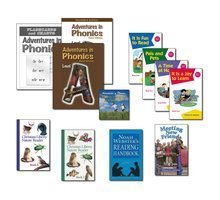
Adventures in Phonics is a series from Christian Liberty Press, this workbook introduces phonetic principles in a logical sequence. The consistent drills and repetition of concepts will help to ensure mastery as children learn the skills foundational to fluent reading abilities.

