

Trish is the owner of Hip Homeschool Moms. She also owns Weird, Unsocialized Homeschoolers, Homeschool Travel Adventures, Only Passionate Curiosity and Love These Recipes! She has been married to her best friend, David, for 25 years and they have three sons (ages 23, 22 and 18). Trish is from the coast of North Carolina, but they now live in rural West Tennessee on a 40+ acre farm. She has been homeschooling since 2009 and her homeschool style leans towards a Montessori approach with a heavy emphasis on hands-on learning. Trish’s family is Messianic and they love studying the Scriptures, learning Hebrew and growing in their faith and walk daily. In her spare time, Trish loves to travel, write, work in their garden and can regularly be found trying to learn something new, modeling that learning is indeed a life-long endeavor!
Similar Posts
How to Make Doll Clothes
Because I want to encourage young children back to the wonderful art of sewing, I have designed an online video course which is perfect for teaching children how to sew their very own doll clothes. It has over 130 step-by-step instructional videos covering everything from explaining the different types of fabric, how to use various sewing tools and how to sew basic stitches through to attaching frills and working with elastic. The course also includes 8 free pdf doll clothes patterns with step-by-step video instructions to help get them started!
Classical Phonics
Classical Phonics is a deceptively simple little book our teachers and families use constantly in both kindergarten and first grade. It consists of phonetically arranged word lists for students to practice their growing phonics skills. In a word list there are no context clues, so the learner must rely on his mastery of letter sounds. For instance, if your child can pronounce each word in this list correctly – pot, pat, pit, put, pet – he knows his short vowel sounds, and you can move on to long vowels! If not, he needs more practice, and Classical Phonics is the most effective tool we know of to address the repetition that young ones need when learning to read. Classical Phonics can be used as a supplement to any phonics program, and covers nearly all English phonograms and sounds taught through second grade. Classical Phonics is your handy tool for phonics practice and for building confident readers.
Life of Fred
Life of Fred is a complete math program that relies upon the self-teaching learning style many homeschoolers love. The texts follow the life of Fred Gauss—a six-year-old math professor at Kittens University who was born on the slopes of the Siberian Mountains—who has many humorous, unlikely, and zany adventures. Informal in tone and approach, these books are designed to engage students in a fun narrative while also instilling a solid understanding of the principles of mathematics–without an abundance of repetitive drills!
The program is structured in different courses that cover multiple grades:
Elementary and intermediate books for 1st-5th grade A “Before High School Mathematics” series that features arithmetic & pre-algebra books for late elementary and middle school A four-year high school course A set of university-level textbooks

All About Spelling
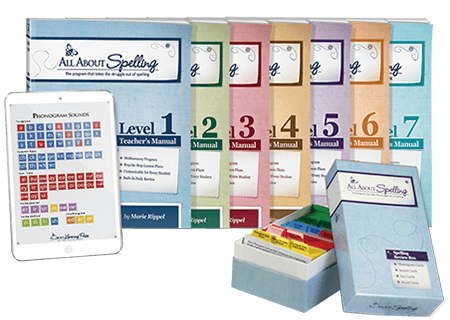
All About Spelling is a seven level program. It teaches encoding skills, reliable spelling rules, and multisensory strategies to help your student become a proficient speller for life. Based on the latest research, this award-winning program provides complete and comprehensive instruction using the Orton-Gillingham approach. We take the struggle out of spelling!
The County Fair
Head back in time with Laura as we take a 12 week tour reading aloud “Little House in the Big Woods”. 18 crafts, hands-on activities and lessons are included as you prepare for a Gold Miner’s Camp Party and gathering up all your handicrafts for the local or state fair.
Holly takes you step by step in this easy to follow unit study that will thrill the whole family.
Make a rag doll, a chromatrope, a ribbon book, a weaving activity, cook, sew, manners and a host of prairie fun.
Spelling-You-See
Spelling-You-See levels:
Listen and Write: Your child is beginning to experience the printed page and needs your help to develop concepts of how spelling works and how letters are formed and put together to make words.Listen and Write is a fun and natural way to ease your child into the world of English spelling. In this level your child will learn correct pencil grip, correct letter formation, consonants, and short vowels. Listen and Write will provide your child with the foundation they need to become confident, competent spellers.
Jack and Jill: Jack and Jill uses fun and engaging nursery rhymes to teach spelling skills and introduce new words. Nursery rhymes tell a story, helping students develop an understanding of simple narrative sequences and provide expanded opportunities for vocabulary development. Easy to say and easy to learn, nursery rhymes add an indispensable auditory component to this level.
Wild Tales: Wild Tales will continue your student’s journey through the skill development stage of spelling. For the first seven weeks, your student will continue to work with the nursery rhyme theme from Jack and Jill before transitioning into nonfiction passages about animals beginning in Lesson 8. Students will read a passage with the instructor each day. Guided reading helps readers of all ability levels become familiar with the passage. Students will also “chunk” the appropriate letter patterns indicated for that day’s lesson and will have opportunities for copywork, free writing, and writing from dictation throughout the week.
Americana: In Americana, students will read nonfiction stories about American history and culture while learning to spell new words in an interesting context. Americana utilizes the three core activities of Spelling You See: chunking – which provides hands-on experience with English’s many irregular letter patterns, copywork – which requires the brain to pay attention to details in print, and dictation – which gives an opportunity for student to demonstrate decoding and encoding in a meaningful context.
American Spirit: American Spirit continues to guide students through the skill development stage of spelling. Students will read about various people and events from American history, with a gradually increasing reading level. At the same time, the emphasis on the mastery of everyday words continues, building a strong foundation for the next stage of spelling. Just as in the previous level, American Spirit utilizes the three core activities of Spelling You See: chunking – which provides hands-on experience with English’s many irregular letter patterns, copywork – which requires the brain to pay attention to details in print, and dictation – which gives an opportunity for student to demonstrate decoding and encoding in a meaningful context.